
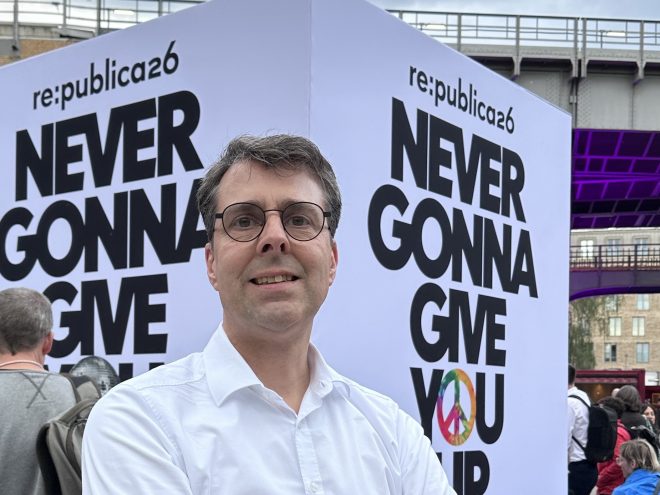
When public space is shrinking and democratic backsliding feels routine, how do you make dissent visible? At re:publica 2026 in Berlin, architect Thomas Schielke offered a luminous answer.
“Never gonna give you up.” The motto of re:publica 2026, Europe’s largest festival for the digital society, drawing thousands of thinkers, activists, and technologists to Berlin each year, set an unexpectedly defiant tone for a conference about culture, technology, and democracy.
Thomas Schielke’s argument was urgent and timely. Climate breakdown, far-right parties normalising themselves in parliaments, democracies hollowed out by algorithm and slow habituation: the problems, Schielke acknowledged, feel larger than the tools available to contest them. Powerlessness, he warned, is the enemy of hope. And hope needs an image – a sign that someone has not stopped. His chosen image was light.
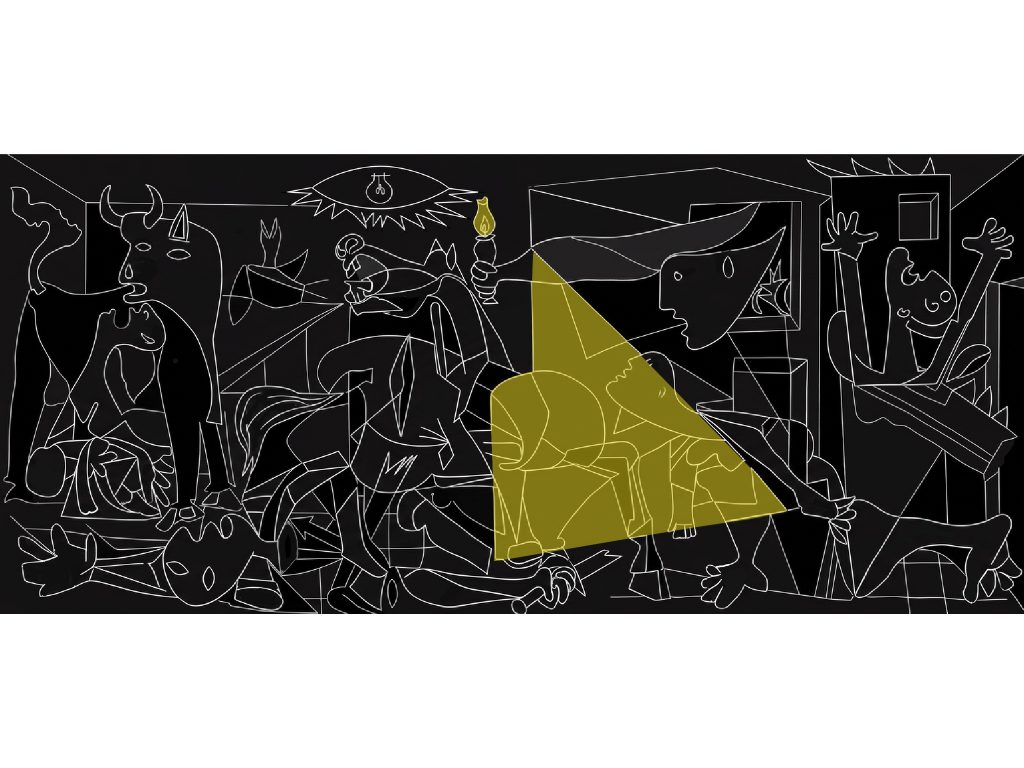
The intellectual arc ran from Picasso’s Guernica – a hand thrusting a lamp into the darkness of the Spanish Civil War, an act not of enlightenment but of refusal – to a living lineage of artists who inherited that gesture. Krzysztof Wodiczko, who in 1983 projected nuclear missile imagery onto Stuttgart’s Victory Column, established the genre’s founding principle: monuments are not neutral, and light can make them argue back. Now 83 and still active, Wodiczko projected in Washington just weeks before this lecture. Greenpeace took the method further, logging more than 650 light interventions on cooling towers, ministry facades, and oil platforms since 1988.
Schielke’s most striking examples were recent. In January 2025, drones assembled letters of light above a crowd in Bochum — weeks before the German federal election, in what he described as likely the world’s first drone protest against right-wing extremism. Earlier, Led by Donkeys and the Zentrum für politsche Schönheit projected onto Tesla’s Gigafactory in Brandenburg.
What makes light so effective? It reaches facades no banner could cover, crosses security perimeters without touching them, and leaves no trace by morning – no paint, no prosecution, only the image in memory and the screenshot in the feed.
Yet Schielke was candid about the limits. Striking images are not legislation. As the form succeeds, it risks being absorbed by the forces it opposes – corporate spectacle, party branding, aestheticised protest without substance. His answer: insist on what follows the moment of wonder. The image must become dialogue, dialogue attitude, attitude action.
Hope, he concluded, is not a feeling one has. It is a decision one takes — particularly in the dark.
Complete recording of the re:publica talk:
(in German, English subtitles available via YouTube)